
Wake County · North Carolina
Water Damage Restoration in Cary, NC
North Carolina Water Damage is a referral service that connects Cary homeowners and property managers with participating independent water damage restoration companies serving Wake County and the Chatham County side of town. Call, and you're routed to a participating company covering your ZIP code when one is available. That company handles the inspection, estimate, and work.
(980) 217-5532 · Availability depends on participating companies in your area
- Mold can start in 24 to 48 hours
- NC homeowners policies exclude flood
- Water categories set by IICRC S500
- Photograph damage before cleanup
Water damage help in Cary
Cary grew fast. The town went from about 22,000 people in 1980 to more than 94,000 in 2000 and about 175,000 in 2020, according to the Census. That means a large share of Cary's homes were built in the 1980s and 1990s, and the age of a house tells you a lot about how its plumbing is likely to fail.
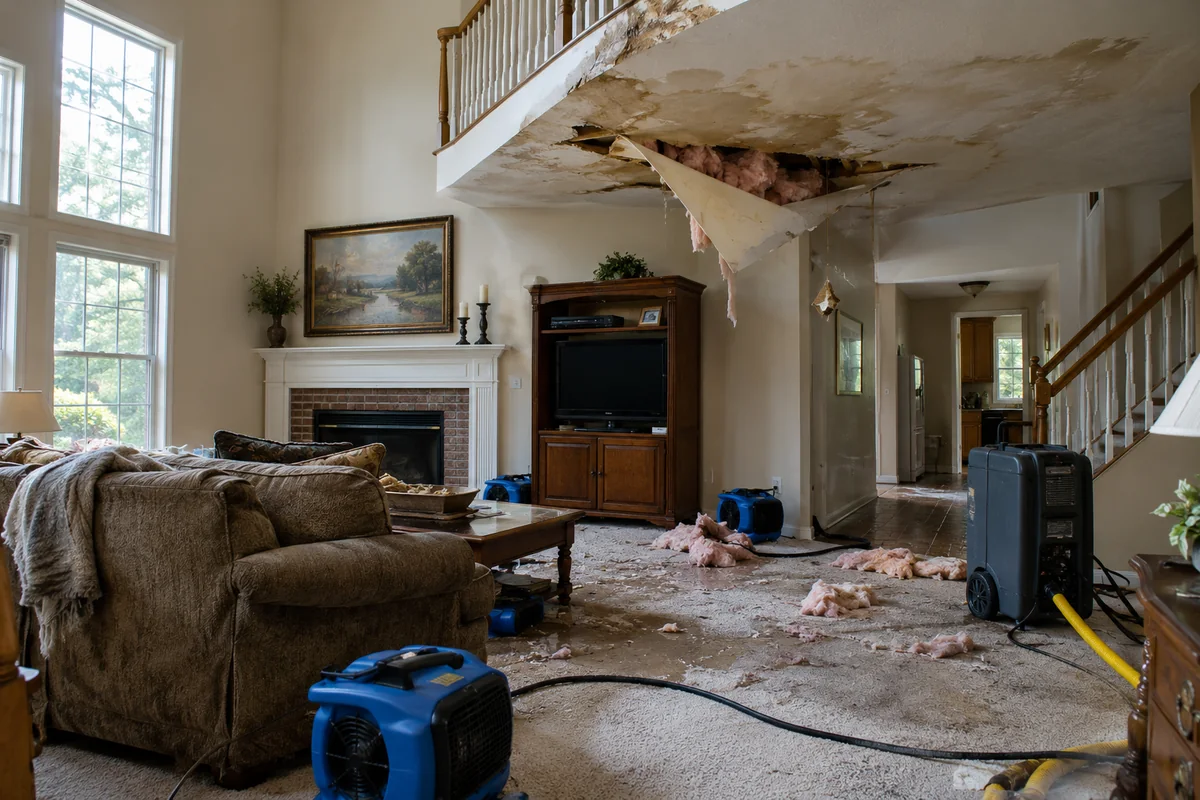
Unlike Raleigh or Wilmington, Cary's water damage story is mostly about what's inside the walls: supply lines, water heaters, and fittings in two-story homes where a leak upstairs comes through the ceiling downstairs.
What goes wrong
Common water damage problems in Cary
Polybutylene supply pipe
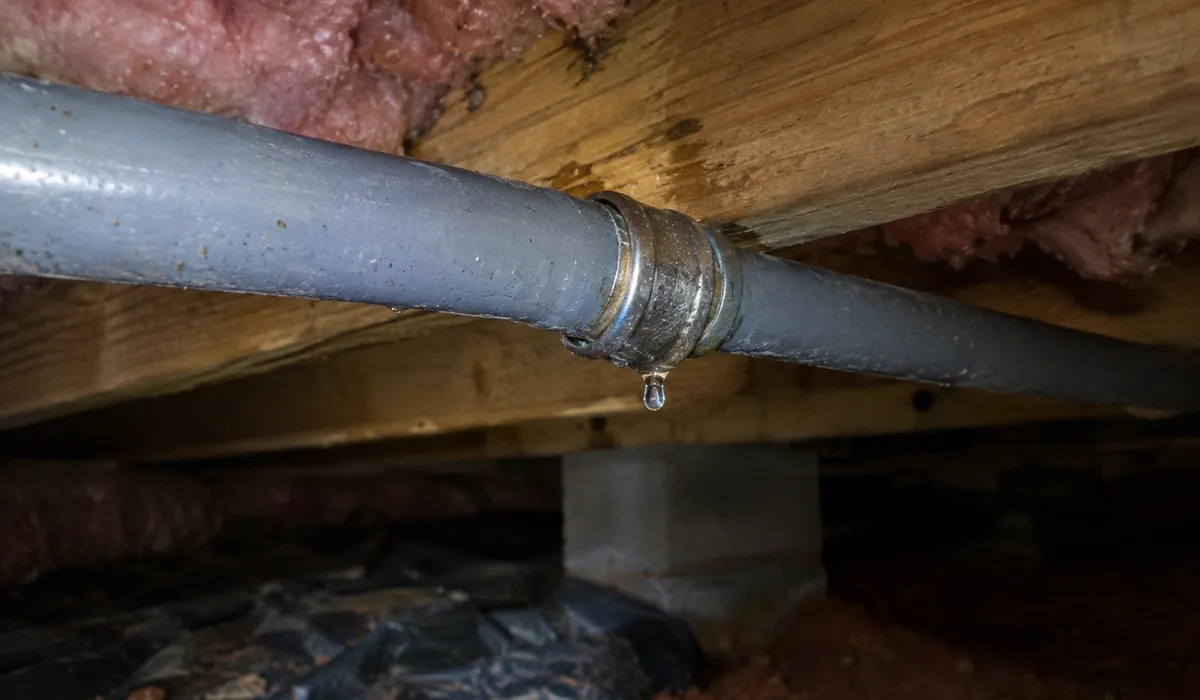
Gray plastic supply pipe was installed in homes from about 1978 to 1995, squarely in Cary's building boom. It's known for failures at the fittings.
Upstairs leaks through ceilings
Two-story homes put bathrooms and laundry over living space. A failed supply line upstairs soaks ceiling drywall below.
Aging water heaters
Tank water heaters have a limited service life, and many in older Cary homes are in garages, closets, or attics where a leak spreads.
Stormwater in low-lying lots
Rapid upstream development has pushed more runoff into creeks like Walnut and Swift Creek, and the town now manages both basins for flooding.
Services
Restoration services Cary homeowners may need
Participating companies offer different service mixes, so confirm the specific work with the company you're connected with. Each guide below explains what the service involves.
Water Damage Restoration
What a restoration company actually does after a leak, burst pipe, or flood, what it typically costs, and how to reach a participating company that serves your part of North Carolina.
Details →Emergency Water Removal
Standing water from a burst pipe, failed water heater, or overflow needs to come out fast. Here's what professional water extraction involves and how to reach a participating company near you.
Details →Flood Damage Cleanup
River, creek, stormwater, and storm-surge flooding is the most serious kind of water damage. What flood cleanup involves, what's safe to do yourself, and how insurance works for floods.
Details →Burst Pipe Water Damage Cleanup
A burst supply line can release a lot of clean water in a short time. What to do in the first minutes, why North Carolina pipes fail, and what professional cleanup involves.
Details →Crawl Space & Basement Water Removal
Many North Carolina homes sit over a crawl space, and that's where leaks and floodwater often end up. What crawl space water removal involves and when it's urgent.
Details →Structural Drying
After extraction, the water left inside floors, walls, and framing has to be dried out with equipment and verified with readings. Here's how structural drying works and how long it takes.
Details →What to do after water damage in Cary
- Shut off the main water valve. In many Cary homes it's in the garage, a utility closet, or the crawl space; the meter box at the street has a shutoff too.
- Stay out from under a sagging ceiling. Wet drywall can drop without warning.
- Note what kind of pipe failed and photograph it. If it's gray plastic, tell your plumber and insurer.
- Call your insurer; a sudden burst pipe is usually covered.
- Start drying within 24 to 48 hours, per EPA guidance, to limit mold in wall and ceiling cavities.
More detail in our guide to what to do immediately after water damage.
How the referral works
How contractor matching works in Cary
You call the number on this site
Have the property's Cary address or ZIP code ready, plus a short description of what happened: a burst pipe, flooding, a leak, a wet crawl space.
Your call is routed to a participating company
Your call is connected with a participating independent restoration company that serves your area, if one is available. We do not send a crew ourselves.
You deal with that company directly
The restoration company inspects, quotes, and does the work under its own name, license, and insurance. You decide whether to hire them; there is no obligation.
Good to know: availability depends on which participating companies cover your ZIP code and how busy they are. Ask the company you're connected with about its license, insurance, written estimate, and timeline before work starts. Our water damage guides cover what to ask.
Local information: Cary's housing boom and its plumbing
Cary's building boom overlapped the polybutylene years. Polybutylene pipe was used in homes from about 1978 to 1995. Its makers settled a class action in 1995; more than 15,000 North Carolina homeowners were replumbed under it, and about 20,000 more had claims rejected. WRAL reported on a Cary homeowner whose polybutylene line burst and brought her ceiling down, with about $8,000 in replumbing costs on top of the damage. The settlement's claim window has long since closed (WRAL).
Not all polybutylene fails, and its presence alone isn't a defect. The NC Real Estate Commission's position is that the mere presence of polybutylene isn't a material fact a seller's agent must disclose, but a known problem with it is (NCREC). Failures are most often reported at insert-type fittings. If you have it, a licensed plumber can tell you whether replacing it makes sense.
Cary manages stormwater basin by basin. In 2018 the town began adaptive stormwater management in the Walnut Creek basin to monitor and reduce flood impacts, and it has since extended the approach to the Swift Creek basin. The water feature at Downtown Cary Park doubles as stormwater control and is designed to cut downstream flow rates by 40% (Town of Cary). Homes near those creeks should still check flood maps; homeowners insurance doesn't cover flood.
Questions
Water damage questions from Cary
How do I know if my Cary home has polybutylene pipe?
Look where supply lines are exposed: at the water heater, under sinks, or in the crawl space. Polybutylene is usually gray (sometimes blue or black) and often stamped PB2110. Homes built in Cary between about 1978 and 1995 are the most likely to have it.
Does insurance cover a burst polybutylene pipe?
The water damage from a sudden burst is usually covered as sudden and accidental, minus your deductible. Some insurers ask about polybutylene when writing a policy, and replacing the pipe itself is typically not covered. Check your policy.
How much does water damage restoration cost in Cary?
There's no Cary-specific price data. HomeAdvisor's 2026 national figures put most jobs between $1,383 and $6,369, averaging $3,868. A ceiling leak that also needs drywall replacement adds repair costs, typically $450 to $1,600 for the ceiling alone.
My upstairs bathroom leaked through the ceiling. Can the ceiling be saved?
Sometimes. If the drywall is only stained and dries quickly, it may be dried in place and repainted. If it's sagging, soft, or the leak involved toilet water, the wet section is usually cut out so the cavity and insulation can dry.
Is North Carolina Water Damage based in Cary?
No. North Carolina Water Damage is a statewide referral service. It connects Cary callers with participating independent restoration companies that serve the area; those companies do the work.
Find Water Damage Help in Cary
Call and we'll try to connect you with a participating independent restoration company that serves Cary and Wake County.