
Statewide contractor referral service
Water Damage Restoration Help Across North Carolina
Connect with participating local restoration professionals for flooding, water extraction, burst pipes, and emergency water damage cleanup.
- One call instead of calling around
- No charge and no obligation
- North Carolina insurance and cost facts
- Clear about how this service works
- Mold can start in 24 to 48 hours
- NC homeowners policies exclude flood
- Water categories set by IICRC S500
- Photograph damage before cleanup
Why start here
Why North Carolina homeowners start with us
North Carolina Water Damage is an independent water damage referral service for North Carolina. When water is coming through the ceiling, you don't have time to research restoration companies, decode insurance rules, and figure out what a fair price looks like. This site is built to handle that part for you.
One call, not ten
Skip searching and leaving voicemails with a list of companies. Your call is routed to a participating restoration company that serves your area, when one is available, so you can spend the next hour protecting your home.
Free, with no obligation
We don't charge you for the referral. The company you're connected with gives you its own estimate, and you decide whether to hire it.
Know a fair price before anyone arrives
Our cost guide shows published price ranges by water type, with sources, so an estimate is something you can judge rather than just accept.
Try the cost calculator →North Carolina insurance, explained
Homeowners policies here cover a burst pipe but not a flood. Knowing which applies before you call your insurer can save you a denied claim and a lot of frustration.
What insurance covers →Local knowledge, not a template
Our city pages cover each city's real flood history, problem areas, and city programs, from Charlotte's sewer-backup policy to Wilmington's tidal flooding.
Find your city →Straight about how this works
We're a referral service, not a contractor, and we say so on every page. The company you're connected with is an independent business that inspects, quotes, and does the work under its own name.
How referrals work →How the referral works
How our contractor-matching service works
You call the number on this site
Have the property's address or ZIP code ready, plus a short description of what happened: a burst pipe, flooding, a leak, a wet crawl space.
Your call is routed to a participating company
Your call is connected with a participating independent restoration company that serves your area, if one is available. We do not send a crew ourselves.
You deal with that company directly
The restoration company inspects, quotes, and does the work under its own name, license, and insurance. You decide whether to hire them; there is no obligation.
Good to know: availability depends on which participating companies cover your ZIP code and how busy they are. Ask the company you're connected with about its license, insurance, written estimate, and timeline before work starts. Our water damage guides cover what to ask.
Water damage services
Main water damage restoration services
What each service involves, when you need it, and what to ask. Participating companies offer different mixes of services, so confirm the specific work when you're connected.
Water Damage Restoration
What a restoration company actually does after a leak, burst pipe, or flood, what it typically costs, and how to reach a participating company that serves your part of North Carolina.
Learn more →Emergency Water Removal
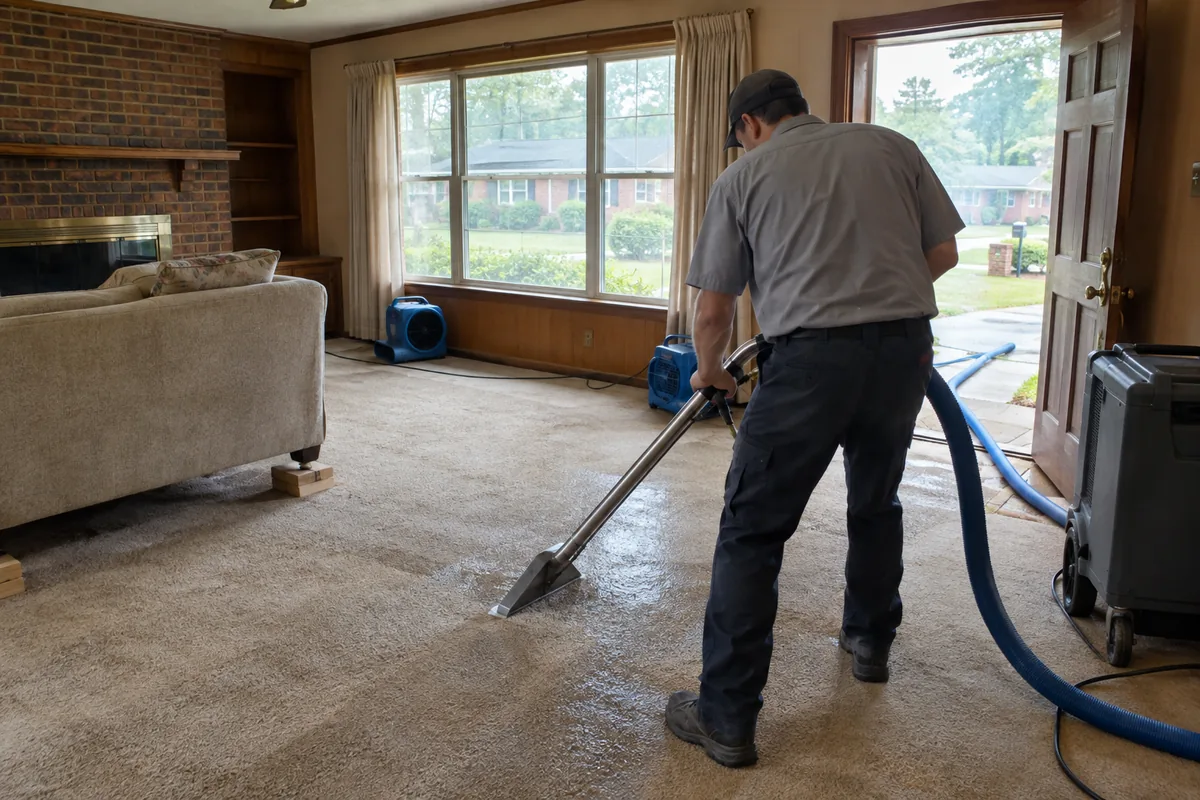
Standing water from a burst pipe, failed water heater, or overflow needs to come out fast. Here's what professional water extraction involves and how to reach a participating company near you.
Learn more →Flood Damage Cleanup
River, creek, stormwater, and storm-surge flooding is the most serious kind of water damage. What flood cleanup involves, what's safe to do yourself, and how insurance works for floods.
Learn more →Burst Pipe Water Damage Cleanup
A burst supply line can release a lot of clean water in a short time. What to do in the first minutes, why North Carolina pipes fail, and what professional cleanup involves.
Learn more →Crawl Space & Basement Water Removal
Many North Carolina homes sit over a crawl space, and that's where leaks and floodwater often end up. What crawl space water removal involves and when it's urgent.
Learn more →Structural Drying
After extraction, the water left inside floors, walls, and framing has to be dried out with equipment and verified with readings. Here's how structural drying works and how long it takes.
Learn more →Spot it early
Common signs of water damage
- Brown or yellow stains on ceilings, often in rings
- Paint that bubbles or peels, or drywall that feels soft
- Floors that cup, buckle, or feel spongy underfoot
- A musty smell, especially from below the floor or inside cabinets
- A water bill that jumps with no change in use
- Standing water or wet insulation in the crawl space
Where it comes from
Common causes in North Carolina homes
Burst and frozen pipes
Hard freezes are infrequent across much of the state, so pipes in crawl spaces and exterior walls are often unprotected when one arrives.
Appliance and water heater failures
Supply lines, dishwashers, washing machines, and ice makers are the everyday causes.
Storms and hurricanes
Wind-driven rain and roof damage, from coastal hurricanes to inland storms like Helene.
Flooding and stormwater
Rivers, creeks, and surface water. This is excluded from homeowners insurance.
Sewer backups
Wastewater forced up through floor drains and lower-level fixtures.
Right now
What to do immediately after water damage
Stop the water
Close the main shutoff valve, or the valve behind the fixture that failed.
Make it safe
Stay out of standing water near outlets or appliances. Turn off power at the breaker only if you can reach it without stepping in water. Stay out from under a sagging ceiling.
Document it
Photograph and video the damage, the source, and damaged belongings before anything is moved or thrown away.
Call your insurer
Report the loss and ask about your deductible, coverage for the cause, and any limits on mitigation.
Get drying started fast
The EPA recommends drying wet materials within 24 to 48 hours to prevent mold.
Service areas
North Carolina service-area directory
Local pages cover each city's flood history, common water problems, and city programs. You can call from anywhere in the state; availability depends on participating companies in your area.
What restoration involves
The water damage restoration process, step by step
This is the standard sequence professional restoration companies follow. Knowing it helps you judge whether a job is being done properly.
Inspection and moisture mapping
The restoration company finds the water source, identifies the water category (clean, gray, or black under the IICRC S500 standard), and maps how far moisture has spread into floors, walls, and framing with moisture meters.
Water extraction
Standing water is pulled out with truck-mounted or portable extractors. Extraction removes far more water than drying ever will, so it comes first.
Removal of what can't be saved
Saturated carpet pad, swollen particleboard, and wet insulation usually come out. After sewage or floodwater, porous materials that touched the water are removed.
Structural drying
Air movers and dehumidifiers run for several days while the technician takes daily readings until materials reach dry targets.
Repairs
Drywall, flooring, and trim are replaced once everything reads dry. Some restoration companies handle rebuild themselves; others refer it out.
Protect yourself
Five questions to ask any restoration company
Whether you're connected through us or find a company on your own, these questions separate a careful job from an expensive mess.
Will you put the estimate in writing before work starts?
Emergency extraction may start right away, but tear-out and repairs should be scoped and priced in writing first.
What water category and class are you pricing?
The IICRC S500 categories (clean, gray, black) and classes drive the price. A good company tells you which applies and why.
Will I get daily moisture readings and photos?
They prove the job is actually dry and support your insurance claim.
Are you insured, and do you need a contractor license for this job?
North Carolina requires a general contractor license for projects of $40,000 or more.
Do you handle the repairs, or only the drying?
Some companies rebuild; others hand that off. Know before you sign.
Insurance
Insurance and restoration: what North Carolina homeowners should know
Usually covered
Sudden and accidental water damage: a burst pipe, a failed supply line, rain through a roof damaged by wind or a fallen tree.
Usually not covered
Flood and rising water, long-term leaks and seepage, and damage tied to poor maintenance. Sewer backup needs an endorsement.
Flood needs its own policy
Flood insurance through the NFIP usually has a 30-day waiting period. After Helene, fewer than 1% of affected western NC households had it.
Details and sources in our guides: does homeowners insurance cover water damage in NC? and water damage vs. flood damage.
Questions
Water damage questions, answered
Is North Carolina Water Damage a restoration company?
No. North Carolina Water Damage is a referral service. When you call, you are connected with a participating independent water damage restoration company that serves your area, if one is available. That company inspects the damage, gives you a price, and does the work under its own name, license, and insurance.
Does it cost anything to call?
We do not charge you for the referral. The restoration company you are connected with will quote its own price for any work, and you are under no obligation to hire it.
How much does water damage restoration cost in North Carolina?
There's no reliable statewide price list, so most estimates use national data. HomeAdvisor's 2026 figures put the average at $3,868, with most jobs between $1,383 and $6,369, and about $3.50 to $7.50 per square foot depending on how contaminated the water is. Sewage and floodwater cost the most.
Does homeowners insurance cover water damage in North Carolina?
Usually for sudden and accidental damage, like a burst pipe or rain through a storm-damaged roof. Homeowners policies exclude flood and rising water, which needs a separate flood policy. Sewer or drain backup is usually covered only if you added an endorsement. Check your own policy and deductible.
How fast does mold grow after water damage?
The EPA advises drying water-damaged materials and furnishings within 24 to 48 hours to prevent mold growth. North Carolina humidity slows natural drying, which is why getting water extracted and drying equipment running quickly matters.
Which parts of North Carolina do you cover?
You can call from anywhere in North Carolina. Whether a participating restoration company is available depends on your ZIP code and how busy companies are at that moment. We have detailed local pages for Charlotte, Raleigh, Wilmington, Cary, and Gastonia, with more cities being added.
Find Water Damage Help Near You
Call and we will try to connect you with a participating independent water damage restoration company that serves your area.