
Mecklenburg County · North Carolina
Water Damage Restoration in Charlotte, NC
North Carolina Water Damage is a referral service that connects Charlotte homeowners, landlords, and property managers with participating independent water damage restoration companies serving Mecklenburg County. Call, and your call is routed to a participating company that covers your ZIP code when one is available. That company inspects the damage, gives you a price, and does the work.
(980) 217-5532 · Availability depends on participating companies in your area
- Mold can start in 24 to 48 hours
- NC homeowners policies exclude flood
- Water categories set by IICRC S500
- Photograph damage before cleanup
Water damage help in Charlotte
Charlotte's water damage calls fall into two broad groups. The first is plumbing failure inside the house: supply lines, water heaters, dishwashers, ice-maker lines, and the occasional frozen pipe. These are the most common losses everywhere, and in a city of about 875,000 people (2020 Census) they happen every day.
The second group is water from outside: creeks that leave their banks after heavy rain, stormwater that pours into low lots, and sewer lines that back up through floor drains and lower-level toilets. Charlotte has a long, documented history with both, and both come with insurance and city-program questions that a burst pipe doesn't.
What goes wrong
Common water damage problems in Charlotte
Creek flooding after heavy rain
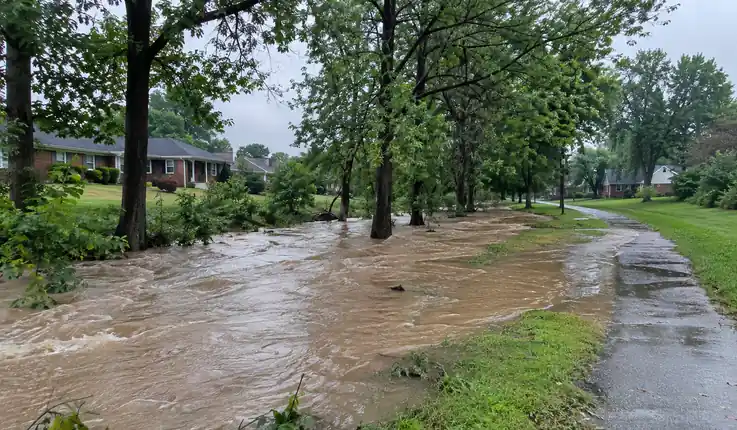
Little Sugar, Briar, Irwin, McAlpine, and Charlotte's other creeks rise fast in heavy rain, and lots nearest the stream flood first. Flood damage is excluded from homeowners policies.
Sewer backups through floor drains
A blocked or overloaded sewer main can push wastewater up through the lowest drain in the house. That's Category 3 water, and porous materials it touched usually have to go.
Burst and frozen pipes
Charlotte freezes less often than the mountains, which is why pipes in crawl spaces, garages, and exterior walls often aren't protected when a hard freeze arrives.
Appliance and water heater leaks
A failed supply line or water heater on an upper floor sends water through ceilings. In a crawl-space house it runs down into the crawl space, where it can sit unnoticed.
Services
Restoration services Charlotte homeowners may need
Participating companies offer different service mixes, so confirm the specific work with the company you're connected with. Each guide below explains what the service involves.
Water Damage Restoration
What a restoration company actually does after a leak, burst pipe, or flood, what it typically costs, and how to reach a participating company that serves your part of North Carolina.
Details →Emergency Water Removal
Standing water from a burst pipe, failed water heater, or overflow needs to come out fast. Here's what professional water extraction involves and how to reach a participating company near you.
Details →Flood Damage Cleanup
River, creek, stormwater, and storm-surge flooding is the most serious kind of water damage. What flood cleanup involves, what's safe to do yourself, and how insurance works for floods.
Details →Burst Pipe Water Damage Cleanup
A burst supply line can release a lot of clean water in a short time. What to do in the first minutes, why North Carolina pipes fail, and what professional cleanup involves.
Details →Crawl Space & Basement Water Removal
Many North Carolina homes sit over a crawl space, and that's where leaks and floodwater often end up. What crawl space water removal involves and when it's urgent.
Details →Structural Drying
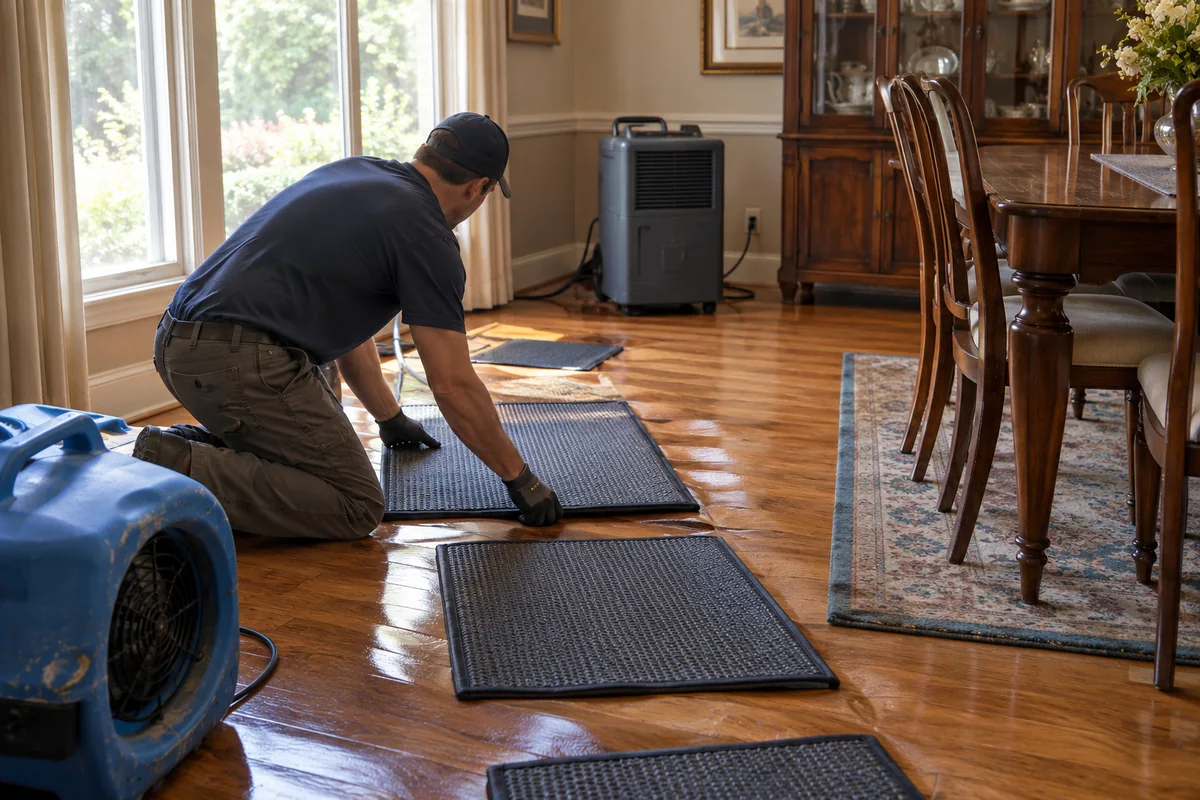
After extraction, the water left inside floors, walls, and framing has to be dried out with equipment and verified with readings. Here's how structural drying works and how long it takes.
Details →What to do after water damage in Charlotte
- Shut off the water at the main valve. Charlotte Water meters are usually in a box near the street; the house-side shutoff is often in the crawl space, garage, or a utility closet.
- If it's a sewer backup, stop running water and flushing, keep children and pets away, and report it to Charlotte Water by calling 311 so the city can check the public sewer line.
- If a creek or stormwater flooded the house, don't walk through standing water near outlets, and treat the water as contaminated.
- Photograph the damage and the source before anything is moved or thrown out.
- Call your insurer, then get a restoration company in quickly. The EPA's guidance is to dry wet materials within 24 to 48 hours to prevent mold.
More detail in our guide to what to do immediately after water damage.
How the referral works
How contractor matching works in Charlotte
You call the number on this site
Have the property's Charlotte address or ZIP code ready, plus a short description of what happened: a burst pipe, flooding, a leak, a wet crawl space.
Your call is routed to a participating company
Your call is connected with a participating independent restoration company that serves your area, if one is available. We do not send a crew ourselves.
You deal with that company directly
The restoration company inspects, quotes, and does the work under its own name, license, and insurance. You decide whether to hire them; there is no obligation.
Good to know: availability depends on which participating companies cover your ZIP code and how busy they are. Ask the company you're connected with about its license, insurance, written estimate, and timeline before work starts. Our water damage guides cover what to ask.
Local information: flooding, floodplains, and sewer backups in Charlotte
Charlotte has been buying homes out of the floodplain for 25 years. Little Sugar Creek flooded homes on and near Westfield Road in 1995 and 1997, and the county later spent about $12 million to buy and demolish 68 properties there. Along Briar Creek, 37 flood-prone homes were bought and cleared; the land is now part of the Chantilly Ecological Sanctuary. Countywide, Mecklenburg County Storm Water Services has purchased more than 490 homes since 1999 and relocated more than 785 families and businesses (Mecklenburg County, WFAE).
Mecklenburg maps future flooding, not just current flooding. In 2000, Charlotte-Mecklenburg became the first community in the country to show both FEMA floodplains and "community" floodplains based on expected upstream development on its official maps. You can look up any address on the city's flooding and maps page or call 704-432-RAIN. If your house is near a mapped floodplain, a homeowners policy alone won't cover water that comes in from outside; flood insurance through the NFIP carries a 30-day waiting period, so it has to be in place before the storm.
Charlotte Water has a voluntary sewer-backup assistance policy. Adopted in 1992, it was the first of its kind in North Carolina. For decades it was capped at $15,000; after a 2022 WSOC investigation into a backup that caused nearly $40,000 in damage, city leaders moved to raise that limit (WSOC). Reported terms have included using your own insurance first, signing a release, and installing a backflow prevention device. Ask Charlotte Water through 311 for the current limit and conditions before you sign anything, and keep the restoration company's photos and moisture readings, because the city will want documentation.
Cold snaps hit the plumbing, too. During the December 2022 arctic blast, Charlotte recorded about two dozen water main breaks in 48 hours (WCNC). The same cold freezes uninsulated pipes in crawl spaces and exterior walls. Water from a burst pipe is generally covered by homeowners insurance as sudden and accidental damage.
Questions
Water damage questions from Charlotte
Will the city pay if a sewer backup floods my Charlotte home?
Possibly. Charlotte Water has had a voluntary sewer-backup assistance policy since 1992. Its long-standing $15,000 cap drew criticism in 2022 and city leaders moved to raise it. Reported conditions include using your own insurance first and signing a release. Ask Charlotte Water through 311 for the current terms.
How do I find out if my Charlotte home is in a floodplain?
Enter your address on the City of Charlotte's flooding and maps page, or call 704-432-RAIN. Mecklenburg shows both FEMA floodplains and future-conditions "community" floodplains, so a home outside the FEMA line can still be inside the community floodplain.
How much does water damage restoration cost in Charlotte?
There's no reliable Charlotte-only price data. Nationally, HomeAdvisor's 2026 figures put the average at $3,868, with most jobs between $1,383 and $6,369. Sewage and floodwater jobs cost more per square foot than clean-water leaks. A participating company prices your job after inspecting it.
Does homeowners insurance cover a flooded house near a Charlotte creek?
No. Homeowners policies in North Carolina exclude flood and rising water. That damage is covered only by a separate flood policy, usually through the National Flood Insurance Program. A burst pipe or a storm-damaged roof leak is a different story and is generally covered.
Does a Charlotte restoration company need a North Carolina license?
North Carolina requires a general contractor license from the NC Licensing Board for General Contractors for projects of $40,000 or more. Drying-only jobs are often below that. North Carolina has no separate mold remediation license, so ask about IICRC training, insurance, and a written estimate.
Find Water Damage Help in Charlotte
Call and we'll try to connect you with a participating independent restoration company that serves Charlotte and Mecklenburg County.