
Last updated: 2026-10-09
North Carolina Water Damage is a referral service that connects North Carolina homeowners with participating independent restoration companies for burst pipe water damage cleanup. A burst pipe is usually the best-case water loss to have, because the water is clean and the damage is usually covered by insurance. Speed is what keeps it that way.
Why pipes burst in North Carolina
Most burst pipes here come from one of four causes:
- Freezing. Hard freezes are infrequent across much of the state, so pipes in crawl spaces, garages, attics, and exterior walls are often unprotected when one arrives. During the December 2022 cold snap, Charlotte recorded about two dozen water main breaks in 48 hours (WCNC), and plumbers across the Triangle were swamped with frozen-pipe calls (ABC11).
- Polybutylene pipe. This gray plastic supply pipe was installed in homes from about 1978 to 1995. More than 15,000 North Carolina homeowners were replumbed under the 1995 class-action settlement. WRAL reported on a Cary homeowner whose polybutylene line burst and brought down a ceiling (WRAL).
- Failed connectors and supply lines to toilets, sinks, washing machines, and ice makers.
- Water pressure and age: old galvanized steel pipe corrodes from the inside, and high street pressure stresses fittings.
Where the water goes
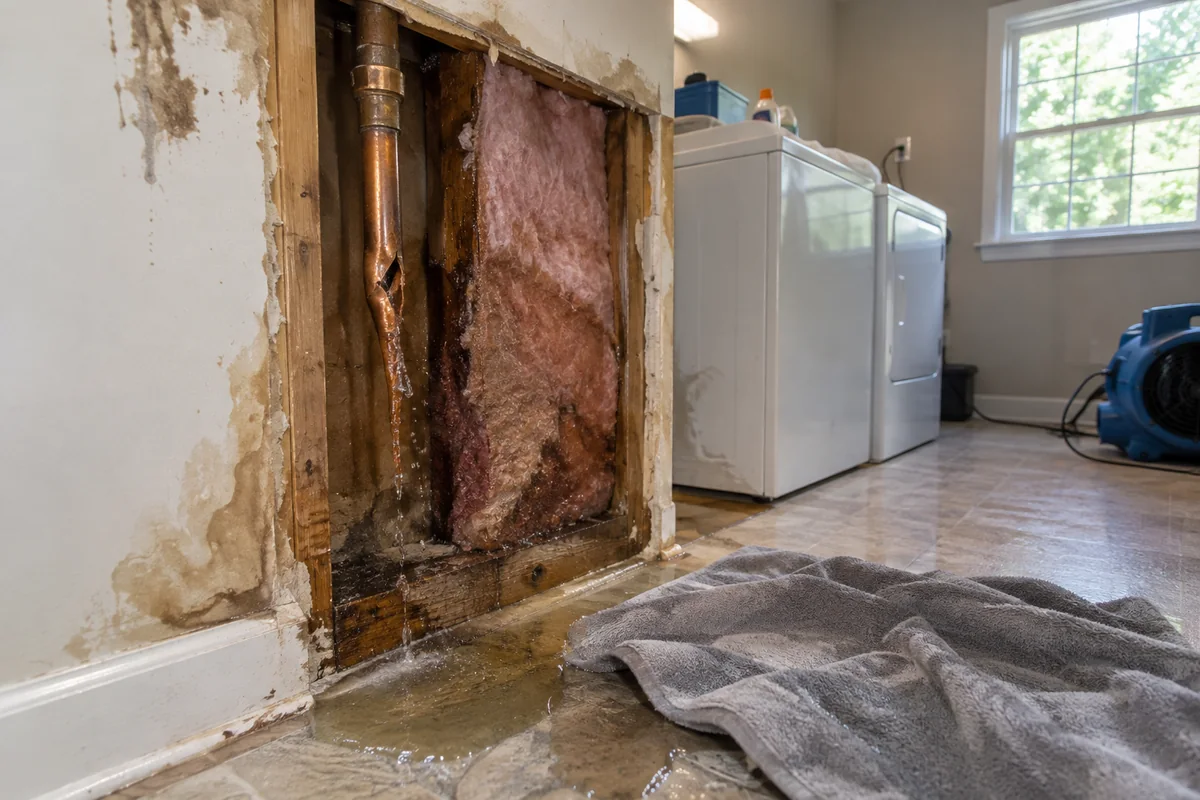
A burst pipe in a wall or ceiling usually sends water downward: through ceiling drywall, into wall cavities, under flooring, and in crawl-space homes, into the crawl space. The visible damage is often smaller than the wet area. A restoration company maps moisture with meters and thermal imaging before deciding what to open up.
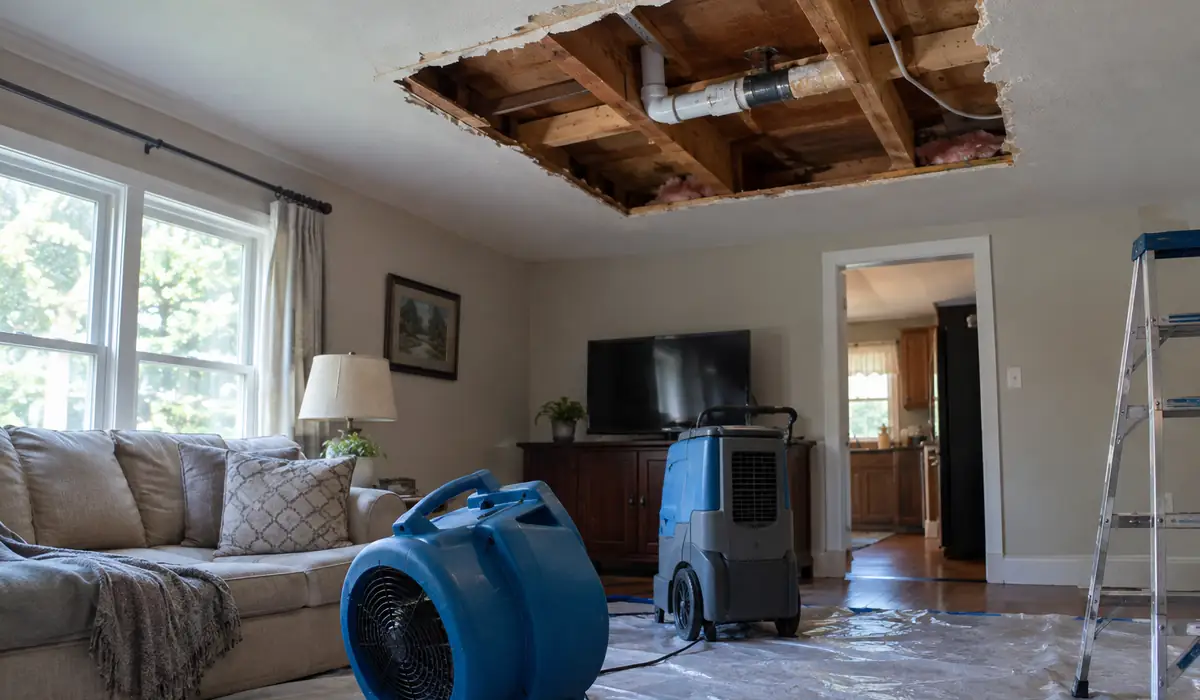
Ceiling drywall soaked from above can sag and collapse without much warning. If a ceiling is bulging or sagging, keep people out from under it.
What burst pipe cleanup involves
The plumbing repair and the water damage cleanup are usually two different companies. A plumber fixes the pipe; a restoration company deals with the water:
- Extraction of standing water from floors and carpet
- Opening walls or ceilings where water is trapped, often with small holes or a cut at the bottom of the wall rather than full removal
- Removing wet insulation and carpet pad
- Setting air movers and dehumidifiers, with daily moisture readings until materials are dry
- Documentation for your insurance claim
Insurance and burst pipes
Homeowners policies generally cover sudden and accidental water damage from a burst pipe, minus your deductible. The pipe repair itself may or may not be covered, depending on the policy. Two common exceptions: slow leaks that went on for weeks, and freeze damage in a vacant house where the heat wasn't maintained or the water wasn't shut off and drained. If you own a second home or rental that sits empty in winter, read that clause. Our insurance guide has more.
When a burst pipe needs professional cleanup
- The pipe was inside a wall, ceiling, or under a floor
- Water came through a ceiling or ran to a lower floor
- Carpet, hardwood, or laminate got wet
- Water ran into the crawl space
- It ran for more than a few minutes before it was shut off
What to do the moment a pipe bursts
- Shut off the main water valve. It's often where the main line enters the house: in the crawl space, a utility closet, the garage, or under the kitchen sink. The meter box at the street has a shutoff too.
- Turn off the water heater if the main is off for more than a short time.
- Open faucets to drain the lines and relieve pressure.
- Keep away from wet ceilings and electrical fixtures.
- Photograph the break and the damage, then call a plumber, your insurer, and a restoration company.